


THE SHORT ANSWER
Reproducibility is the real test of whether scientific data is ready. Not whether a result was written down, but whether it can be rebuilt on demand; by someone else, after the people and the systems have moved on. Most teams can show a result. Fewer can run it again. That gap is where AI validation and regulatory review tend to break.
The request that separates companies
In an evaluation I eventually ask for the same thing. Show me last year’s best result. Then rerun it, start to finish, while I watch.
Most teams can produce the result. The figure, the readout, the number that went into a decision. Fewer can rebuild it. Not because anyone was careless, but because the result was never designed to be produced a second time.
A reproducible result is a different object
A result you cannot reproduce is not a weaker version of one you can. It is a different kind of object. It records that something happened once. It cannot promise it would happen again
The question is not whether it happened. It is whether it can happen again.
That is not a quality gap you close with a better report. The report describes the result. Reproducibility is a property of how the result was made.
Not a niche worry
In 2026 the Brazilian Reproducibility Initiative, more than 50 labs working together, took a set of published biomedical experiments and ran them again. Depending on the criteria, 20% to 44% reproduced. Fewer than half.
This was not a survey or an estimate. It was the experiments, run a second time, by independent labs with nothing to sell. And a 2024 survey in PLOS Biology found that 72% of biomedical researchers already agree there is a reproducibility crisis. The people doing the work are not surprised.
The part I sit with is not the number. It is why so much of it did not rebuild. The initiative traced much of the gap to methods that were written down but never written to be run again: steps left ambiguous, details that lived in one person’s hands.
Records were kept, protocols were written, reports were filed. The work still did not rebuild. Documentation was never the missing piece.
Why ready and rerunnable are the same question
A result reruns only when four things are recoverable together: the inputs, the code, the environment they ran in, and the order they ran in. Lose any one and you can still describe what happened. You cannot reproduce it.
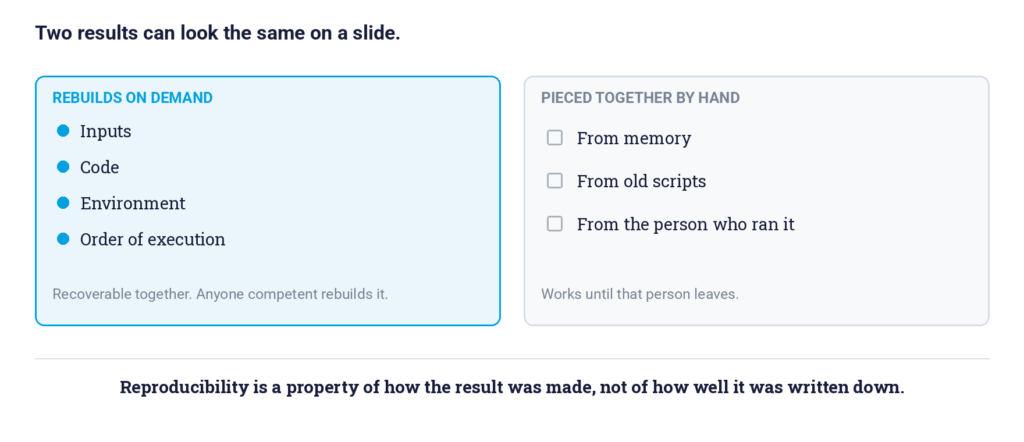
Most systems capture the first and narrate the rest. That is enough to pass an audit of the record. It is not enough to rebuild the result, which is a different and harder guarantee.
What a vendor will not tell you
Here is the concession. Most existing results will never be made rerunnable, and chasing them usually is not worth it. You do not go back and rebuild five years of work. You draw a line. You make everything after it reproducible by default, and you are clear about which side of the line a given result sits on
The stronger version does not rely on discipline
Knowing the line is the minimum. The better arrangement is a system that will not record a result it cannot rebuild, so reproducibility stops being a practice a person maintains and becomes a property of the record itself. That difference holds up when the person who maintained the practice leaves.
The readiness question
The last time you were asked to reproduce a result, could you, or did you have to piece it back together?
Surfacing that in a room costs an afternoon. Discovering it inside an AI validation costs the result, and every decision that leaned on it.
Sources
The Brazilian Reproducibility Initiative, “Estimating the replicability of Brazilian biomedical science,” eLife, reviewed preprint (2026)
Cobey et al., “Biomedical researchers’ perspectives on the reproducibility of research,” PLOS Biology 22(11):e3002870 (2024)