

THE SHORT ANSWER: A year ago, pharma R&D leaders evaluated AI by asking about the model. Now they ask whether a recommendation can still be supported six months after it is made. That shift explains why so many AI programs stall. The model was rarely the constraint. The systems underneath were never built to answer the second question.
The question used to be about the model
A year ago, most AI conversations in pharma R&D opened the same way. Which model? How large? Trained on what? The technology was new enough to be the subject.
That has changed faster than almost anything I have seen in this industry. In the portfolio reviews and steering committees I hear about now, the model barely comes up. What comes up is what happens afterward.
The top-20 pharma leaders I interact with have converged on what I believe is the more important question:
If we pursue a particular AI strategy, can we support our reasoning six months from now?
Not at the demo. Six months out, when a program decision is examined by a partner, a regulator, or whoever inherits the work. Not because the models failed. Because nobody could fully stand behind the output.
Why the shift is happening now
The timing is not a coincidence. Enough programs have reached the point where early AI decisions carry consequences, and the people who made them have moved on.
Gartner put numbers on the gap in February 2025. A July 2024 survey of 1,203 data management leaders found that 63% of organizations either lack the right data management practices for AI or are unsure whether they have them. On that basis, Gartner predicted that through 2026, organizations would abandon 60% of AI projects unsupported by AI-ready data.
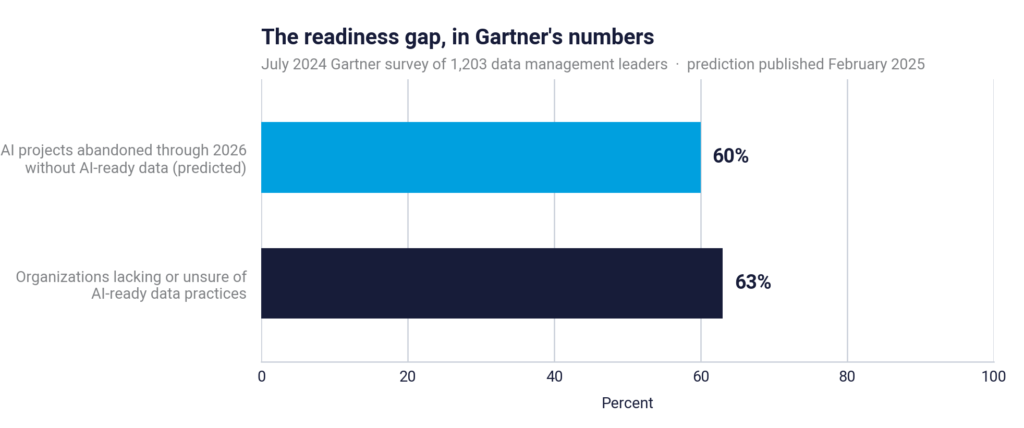
Read the prediction carefully, because the wording carries the argument. It does not say the models underperform. It says projects get abandoned, which is a different kind of failure. Somebody could not stand behind the output when it mattered.
And abandonment is no longer hypothetical. S&P Global’s Voice of the Enterprise: AI & Machine Learning, Use Cases 2025 survey of 1,006 IT and line-of-business professionals across North America and Europe found the share of companies abandoning most of their AI initiatives before they reach production rose from 17% to 42% year over year, with an average of 46% of projects scrapped between proof of concept and broad adoption.
What walking it back involves
The question sounds simple until a team tries it. Take one AI-informed recommendation from last quarter and follow it backwards.
There are five steps.
- Name the exact version of the code that produced the figure.
- Retrieve the inputs as they existed then, not as they exist now.
- Rerun it. Same number?
- Show what changed in between, and who changed it.
- Find the context that turned that number into a decision.
Most organizations manage the first two steps in an afternoon and stall on the third. Almost none reach the last one, because the context was never written down anywhere that outlives the person who did the thinking.
These are risk questions, not model questions
Can we explain how the recommendation was reached? Can we rerun it and get the same answer? Can we scale it without scaling our exposure? None of those are answered by choosing a better model, and all of them are being asked of leaders who inherited an AI budget without inheriting the systems underneath it.
That is an uncomfortable position, and it is where a lot of R&D leadership currently sits. The mandate arrived first. The foundation it depends on was built for an earlier era, when the person who ran the analysis was also the person who explained it; and was still down the hall when the questions came.
What the organizations making progress have in common
It is not budget. The teams I see making steady progress are rarely the ones spending the most. What they share is a decision made early, before anyone was watching:
That trust, governance, scientific rigor and full context are foundational rather than paperwork arranged around the real work.
That decision costs real money in year one and compounds in value every year after. It rarely appears in a strategy deck. Leaders make it quietly, and the results speak later.
The question to take into your next AI review
Which AI-informed decision from last quarter could you walk back to the raw data today, step by step?
If the answer takes more than an afternoon to establish, that is the finding. Not a failure of the model, and not a reason to slow down. It is a measure of the distance between where your AI program is and where it will need to be six months from now.
Sources
Gartner, “Lack of AI-Ready Data Puts AI Projects at Risk,” 26 February 2025. gartner.com
Primary disclosure naming the analyst, survey period and sample size. Both figures appear verbatim.
S&P Global Market Intelligence, Voice of the Enterprise 2025. spgglobal.com
The primary source: a survey of 1,006 midlevel and senior IT and line-of-business professionals across North America and Europe. Both figures appear in S&P’s own wording.