


THE SHORT ANSWER
Scientific data becomes AI-ready in one of two ways: as a consequence of how the work runs, or by being described after the work is finished. On paper the two look identical. The guarantees are not, because a retrofit depends on someone correctly describing afterward what happened, and it is never finished while new work keeps arriving.
Two routes to the same document
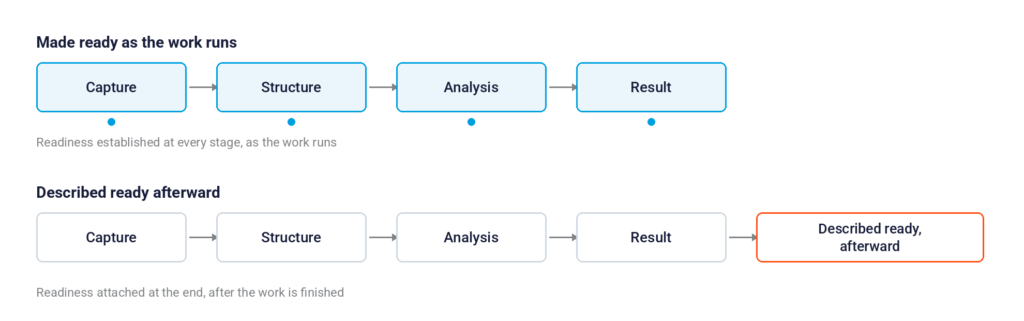
Scientific data becomes AI-ready in one of two ways, and the resulting documents can look nearly identical. What they guarantee could not be more different.
The first route makes readiness a consequence of how the work runs. Structure is enforced as the work happens, and provenance falls out of execution instead of being a separate task somebody owns.
The second attaches readiness to work that has already finished. Someone goes back, describes what happened, and records it.
Why a retrofit does not stay finished
When I ask teams deep into a retrofit what happens to work that ran before the project started, the answer is prioritization. When I ask what happens to the work running now, the pause is longer.
That is the whole problem in one exchange. A race against production, and production does not pause.
It is not an argument that retrofit fails. Retrofit works. What it cannot do is stay finished, because the process that created the backlog is still running.
Retrofit is often the only honest option
Nobody rebuilds twenty years of research because a strategy deck asked them to. For historical work, describing what happened is frequently the only route available, and doing it carefully is real work worth funding.
The distinction that matters is between choosing retrofit for the past and choosing it for the future. The second choice usually gets made without anyone noticing it was a choice.
Retrofit works. What it cannot do is stay finished.
What the two approaches guarantee
Work that produces itself in a ready state carries a record of what the system did. Work made ready afterward carries a record of what somebody believed the system did. Both are useful. Only one of them cannot disagree with the work it describes.
Data that was made ready afterward carries one more assumption: that whoever did the describing understood what happened. Sometimes they did. The work that produces itself in a ready state does not need the assumption.
The readiness question
For the work your team ran last quarter, did readiness happen as part of the work or after it?
If the answer is different for last quarter than it will be for next quarter, that is progress. If it is the same, the retrofit is not a transition. It is the operating model.