

THE SHORT ANSWER
AI adoption across biotech and pharma drops sharply in the areas closest to discovery decisions. The reason is not resistance to change. A scientist who acts on an output they cannot trace or rerun is absorbing risk the organization has not priced; so refusing is the correct professional judgment.
A line worth pushing on
The line I keep hearing this year, in some version, from every corner of the industry: we no longer have a data problem. We have a confidence problem.
Half the industry now says a version of that, which usually means the phrase has stopped doing work. So the better question is where the confidence problem lives, because it is not evenly distributed.
It lives at the bench
Across biotech and biopharma organizations, reported AI adoption reaches 42% for generative molecular design, 40% for biomarker analysis and 29% for ADME prediction, as reported by Drug Discovery News in February 2026.
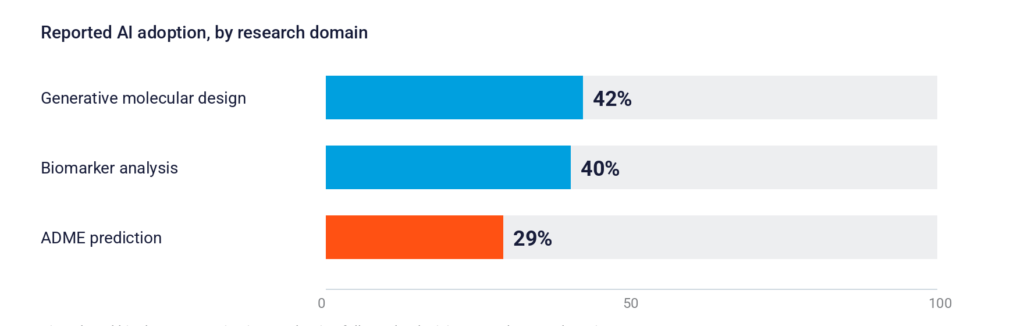
Those are the places where discovery decisions get made. Adoption falls as the stakes of the decision rise, which is the opposite of what a technology adoption curve normally looks like.
Refusing is the correct professional judgment
The standard reading of that data is scientist resistance, and it leads to more training and more change management. I think the standard reading is wrong.
Declining to act on an output you cannot reproduce is not caution.
It is the job.
A scientist who acts on a confident answer they cannot reproduce is not being efficient. They are absorbing risk the organization has not priced and will not acknowledge until something goes wrong. Declining is not conservatism. It is the job.
Confidence is a property of the system, not a state of mind
Which means it cannot be trained into people. It comes from the same inputs and the same code returning the same result, every time, with a record of how it got there. When that is true, adoption follows without a campaign. When it is not, no amount of enthusiasm from leadership will move the number.
This is also why the confidence problem and the data problem are not separate. Confidence is what a well-built foundation feels like from the outside.
The question to take into your next AI review
Would your most careful scientist stake a program decision on this output? If not, what would have to be true?
The second sentence is the useful one. Whatever she names is your roadmap, and it will be shorter and more specific than any maturity assessment you could buy.
Sources
Benchling, 2026 Biotech AI Report, November 2025 survey
Survey of ~104 biotech and biopharma organizations, US and Europe.
Drug Discovery News, The 2026 AI Power Shift, February 2026
DDN’s coverage of the same report