

THE SHORT ANSWER
AI-ready is not a single property. It usually means at least four different things depending on who is asked: stored and documented, accessible without friction, reproducible by a scientist, or defensible to an auditor. Organizations get into trouble when they buy against one definition and are later judged against another.
A question with four correct answers
Every organization I talk to wants AI-ready data. I hear it in first meetings, in RFPs, in board decks. What I almost never hear is what ready means. And when I do receive a definition, it rarely survives the next person in the room.
Ask whether the data is AI-ready and the yes comes fast. Ask what ready means and you get the pause. I have sat through that pause enough times to know what follows: the same four answers, from four different chairs in the same meeting.
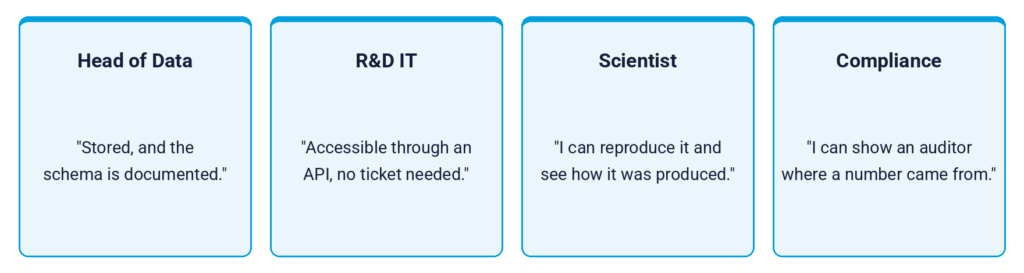
The head of data says it is in the warehouse and the schema is documented. R&D IT says accessible through an API without raising a ticket. A scientist says they can reproduce a result and see how it was produced. The compliance lead says they can show an auditor where a number came from and who changed it.
All four are correct. None of them is the same test.
Why the ambiguity is expensive
This is where it gets expensive, and I have watched it happen more than once. A company buys against one definition and gets judged eighteen months later against another. The tool did what it promised. The promise answered a question nobody had confirmed was the right one.
Gartner predicted that through 2026, 60% of AI projects unsupported by AI-ready data would be abandoned — a figure surveyed across industries, not pharma alone. My guess, and it is only a guess: a meaningful share of those projects involved data somebody inside the organization had already certified as ready. Certified against one of the four definitions. Abandoned against another.
The four definitions are not bought together
This is the part that catches even careful buyers. Findable does not mean reproducible. Accessible does not mean defensible. Each definition implies different work, different systems, different owners. A purchase that satisfies one can leave the other three exactly where they were.
None of the four is wrong. The mistake is treating them as one word.
What to do about it before the next evaluation
My advice is not glamorous. Ask the four people separately, in writing, before anyone drafts a requirements document. The disagreement is the requirements document. Finding it in a room costs an afternoon. Discovering it in year two costs the program.
The readiness question
If you asked four people on your team what AI-ready means, how many answers would you get?
If the answer is one, that is worth verifying rather than celebrating.
Sources
Gartner, “Lack of AI-Ready Data Puts AI Projects at Risk,” 26 February 2025. gartner.com
Primary disclosure naming the analyst, survey period and sample size.