

THE SHORT ANSWER
A catalog describes data and is maintained separately from it, so it can drift out of agreement with what it describes and nothing breaks. A structure constrains how the work runs, so it cannot disagree with the data it holds. Documentation is forensic; structure is preventive. Most organizations have invested heavily in the first.
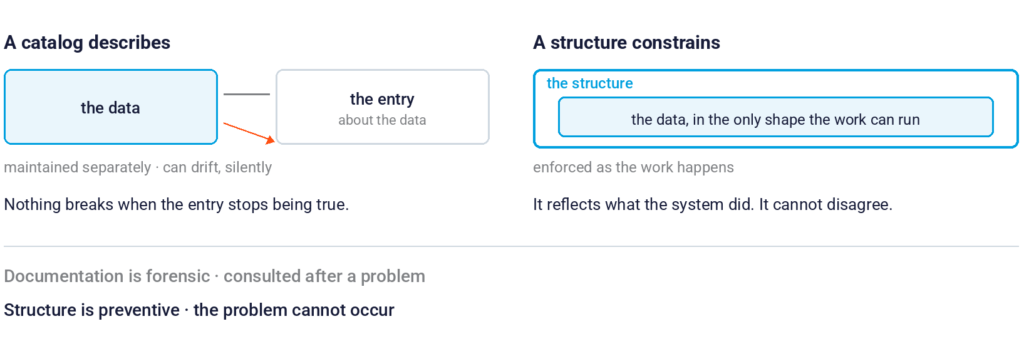
A catalog describes. A structure constrains.
This distinction decides more evaluations than it gets credit for, and it is usually discussed as a tooling preference rather than the difference in guarantee that it is.
A catalog is written alongside the data and maintained by a separate process. It can drift, and when it drifts nothing breaks. The entry still reads correctly. It is simply no longer true.
A structure cannot drift, because work cannot run in a shape the structure does not permit. It does not record what somebody believed. It reflects what the system did.
How you find out a description has gone wrong
Teams show me catalogs covering thousands of datasets, carefully maintained, impressive to walk through. When I ask how they would know if an entry had become wrong, the answer is a version of the same thing: someone would notice, eventually, while using the data.
That is not a criticism of those teams. It is the honest answer, and it is the answer almost everywhere, because a description has no mechanism for reporting its own accuracy. Drift is silent by construction.
Forensic and preventive are different jobs
Documentation is consulted after something has gone wrong, and its value is that it helps you piece together what happened. Structure’s value is that a class of problem cannot occur.
Documentation is forensic. Structure is preventive.
Most organizations have invested heavily in the forensic half and call the result governance. It is worth having. It is not the same as knowing, and the distinction tends to surface at the least convenient moment.
Why AI changes the stakes
A drifted catalog used to mislead one person at a time, slowly, with a human in the loop who might notice something odd. A system reading that catalog at scale will repeat the error consistently and present it with the same confidence as everything else it says.
The readiness question
If a description of your data became wrong tomorrow, what would tell you?
If the answer is a person eventually noticing, that is worth knowing before an AI system starts reading it.