


THE SHORT ANSWER: The gap is whether the work can travel
Pharma R&D organizations share nearly identical AI ambitions, and the spending now matches the ambition. The gap is not strategy or talent. It is whether the work underneath can travel: whether a result can be rerun by someone who did not produce it, and whether a pilot that succeeded in one lab can move to the next.
Identical ambitions, identical budgets
I spend a lot of my week talking with pharma executives, and the ambitions have converged. Everyone wants the same four things.
- Accelerate discovery.
- Shorten development timelines.
- Put AI in the hands of scientists.
- Do it without adding risk.
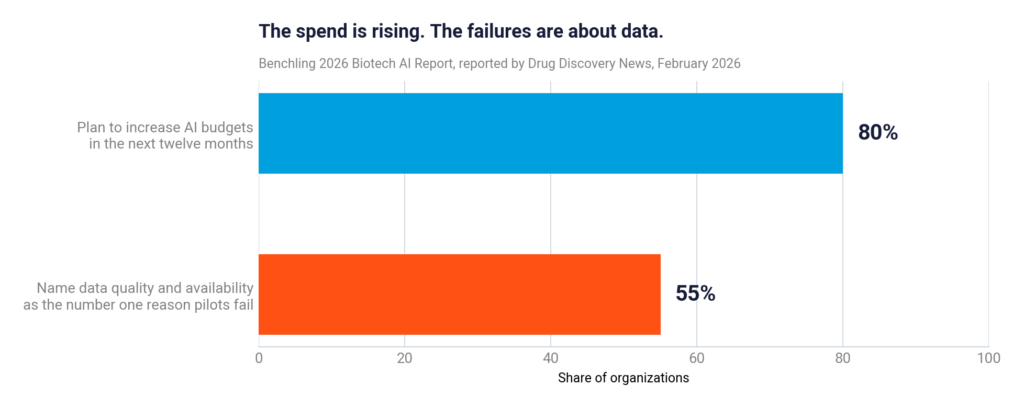
The spending now matches the ambition. In Benchling’s 2026 Biotech AI Report, a survey of biopharma organizations reported by Drug Discovery News in February 2026, 80% of organizations plan to increase their AI budgets in the next twelve months.
Read that number the way I did. If nearly everyone has the same goals, and nearly everyone is raising spend, then neither goals nor spend will decide who wins. Something else will, and it is the one thing that never appears in a strategy deck: where each company is starting from.
Two companies, same strategy
Here is the contrast I keep running into. One company spent six years making every result rerunnable before it bought a single AI license. Another is modernizing in flight, with thirty active programs depending on the systems being replaced. Both call themselves AI-forward. Both are telling the truth.
But ask each one what a new hire would need to reproduce last year’s most important result. Only one has an answer.
Neither the goals nor the budgets will decide who wins. The starting line will.
The gap shows up eighteen months later
The gap never shows up in the pilot. Pilots are run by motivated people with the builder one desk away. It shows up eighteen months later, when the work has to travel: to another team, another site, or simply to next year.
The same report puts a number on why: 55% of organizations name data quality and availability as the number one reason AI pilots fail. Not model choice. Not talent. The condition of the scientific work underneath, and that condition was set years before anyone approved an AI budget.
Preparation is quiet, and it decides the outcome
I have never seen any of it in a press release. Consistent data models. Provenance captured as the work happens, not rebuilt afterward. Workflows that produce the same answer twice. Quiet work. And it decides whether an AI investment compounds or evaporates.
The question to take into your next AI review
If this program had to move to another team or another site tomorrow, what would break first?
Whatever you name is the starting line. Not the strategy, not the budget. The thing you just named.
Sources
Drug Discovery News, “The 2026 AI power shift,” February 2026, reporting the Benchling 2026 Biotech AI Report. https://www.drugdiscoverynews.com/the-2026-ai-power-shift-17020