
DataJoint is a validated Built-on partner in the Databricks Brickbuilder Partner Network (Bronze tier)

  • Six questions to take into your next AI review

    Six questions to take into your next AI review

    Six questions, drawn from six weeks of conversations with pharma R&D leaders, that test whether an AI program will hold up under examination. None of them are technology questions. They can be answered in a room with no laptops open, and the answers say more about readiness than most maturity models.

    Six weeks of listening, six questions

    I started this series expecting to write about models and ended up writing about questions. Six of them kept returning in conversations with pharma R&D leaders, investors and technology partners, and they are collected here in one place.
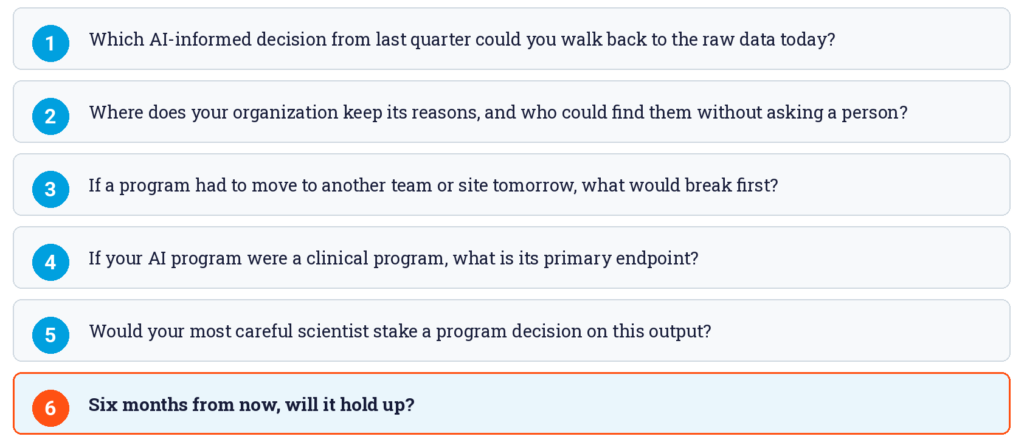
    The six questions. Available as a single page.

    Why questions rather than answers

    Every AI maturity model I have been shown produces a score. Scores are useful for reporting and almost useless for deciding what to do on Monday. A question that cannot be answered points directly at the work.

    None of these are technology questions. They can be answered in a room with no laptops open, by people who know how the work runs.  The answers say more about AI readiness than any assessment I have seen.

    Infrastructure is not the exciting part of AI. It may prove to be the part that decides who gets to keep going.

    How to use them

    Take one into a review that is already scheduled. Do not announce it as an exercise. Ask it in the ordinary course of the meeting and pay attention to how long the room takes to answer.

    The pause is the finding. A question that produces four different answers from four people is telling you something a maturity score would have averaged away.

    The one that matters most

    The sixth question is the whole series. Six months from now, will it hold up? The first five are how you find out, and each takes a different route to the same place: whether the reasoning behind a decision will survive the people who made it.

    One note from outside the list. These questions are not hypothetical. The foundation that institutions built for the world’s most complex multimodal research is now running inside a top-five pharmaceutical company; where the same upstream questions carry higher stakes.

    What those teams share is not budget. It is that they treated readiness as the work, not a cleanup after the AI arrived.

    Which of the six can your organization not yet answer?

    That is the conversation I would like to have next, and it is a better use of a meeting than another readiness assessment.
  • Why scientists reject AI outputs they cannot reproduce

    Why scientists reject AI outputs they cannot reproduce

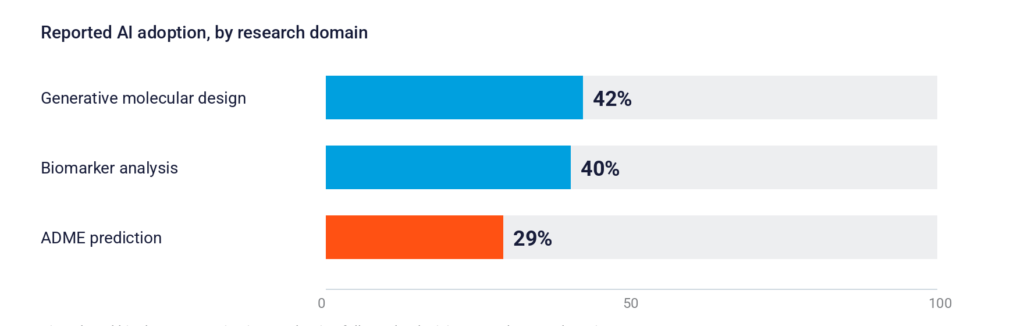
    AI adoption across biotech and pharma drops sharply in the areas closest to discovery decisions. The reason is not resistance to change. A scientist who acts on an output they cannot trace or rerun is absorbing risk the organization has not priced; so refusing is the correct professional judgment.

    A line worth pushing on

    The line I keep hearing this year, in some version, from every corner of the industry:  we no longer have a data problem. We have a confidence problem.

    Half the industry now says a version of that, which usually means the phrase has stopped doing work. So the better question is where the confidence problem lives, because it is not evenly distributed.

    It lives at the bench

    Across biotech and biopharma organizations, reported AI adoption reaches 42% for generative molecular design, 40% for biomarker analysis and 29% for ADME prediction, as reported by Drug Discovery News in February 2026.

    Benchling 2026 Biotech AI Report, a November 2025 survey of ~104 biotech and biopharma organizations. Reported by Drug Discovery News.

    Those are the places where discovery decisions get made. Adoption falls as the stakes of the decision rise, which is the opposite of what a technology adoption curve normally looks like.

    Refusing is the correct professional judgment

    The standard reading of that data is scientist resistance, and it leads to more training and more change management. I think the standard reading is wrong.

    Declining to act on an output you cannot reproduce is not caution.
    It is the job.

    A scientist who acts on a confident answer they cannot reproduce is not being efficient. They are absorbing risk the organization has not priced and will not acknowledge until something goes wrong. Declining is not conservatism. It is the job.

    Confidence is a property of the system, not a state of mind

    Which means it cannot be trained into people. It comes from the same inputs and the same code returning the same result, every time, with a record of how it got there. When that is true, adoption follows without a campaign. When it is not, no amount of enthusiasm from leadership will move the number.

    This is also why the confidence problem and the data problem are not separate. Confidence is what a well-built foundation feels like from the outside.

    Would your most careful scientist stake a program decision on this output? If not, what would have to be true?

    The second sentence is the useful one. Whatever she names is your roadmap, and it will be shorter and more specific than any maturity assessment you could buy.


    Sources

    Benchling, 2026 Biotech AI Report, November 2025 survey
    Survey of ~104 biotech and biopharma organizations, US and Europe. 

    Drug Discovery News, The 2026 AI Power Shift, February 2026
    DDN’s coverage of the same report